
How to Choose the Right Neighborhood in Tennessee: A Buyer's Decision Framework for 2026
Choosing a neighborhood is the most important decision a buyer makes — more than the house itself. Here's a data-driven framework for evaluating Tennessee neighborhoods before you commit.

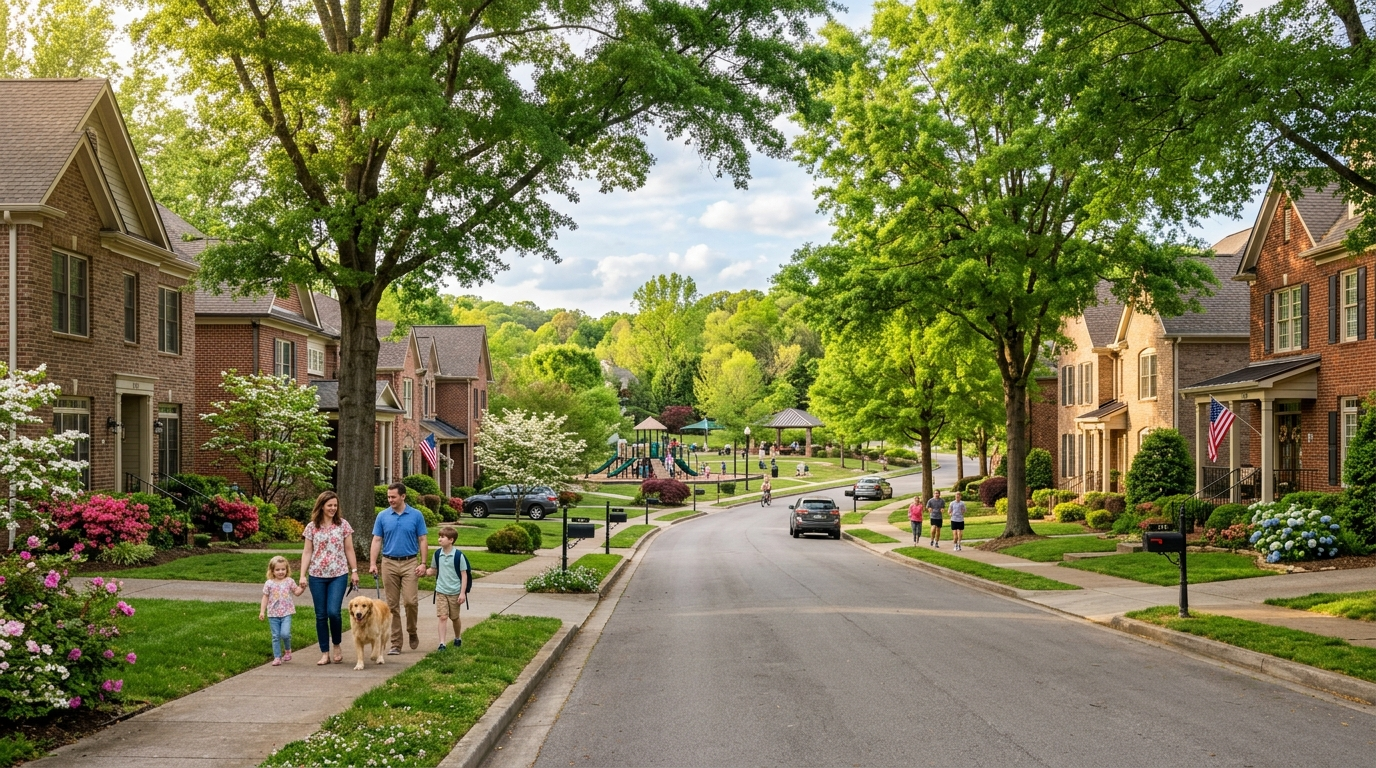
Here's something most buyers learn too late: you can renovate a house, but you can't renovate a neighborhood. The kitchen you hate today can become the kitchen you love in six months for $40,000. But the 45-minute commute, the underperforming school district, or the neighbors with seven cars in the yard? Those come with the address, and they're not changing.
In Tennessee's 2026 market — where the statewide median home price has reached approximately $385,000 and competition remains strong in desirable areas — choosing the right neighborhood isn't just a lifestyle decision. It's a financial one. The same home in two different neighborhoods can appreciate at dramatically different rates over 5–10 years.
This guide provides a practical, step-by-step framework for evaluating Tennessee neighborhoods. It's the process that experienced buyers and real estate professionals use — and it works whether you're looking at Farragut, Franklin, Chattanooga, or a small town in the Tri-Cities.
Step 1: Define Your Non-Negotiables Before You Start Looking
Before you pull up a single listing, write down your top three non-negotiables. Not preferences — requirements. The things that, if missing, make the neighborhood a dealbreaker regardless of how nice the house is.
Common non-negotiables for Tennessee buyers in 2026 include:
- School district: If you have school-age children, this is typically #1. Tennessee's school quality varies enormously by district — and sometimes by school zone within the same district. We'll cover how to evaluate this below.
- Maximum commute time: Set a hard limit. "30 minutes to the office" is specific and testable. "Reasonable commute" is vague and leads to regret.
- Property type: Do you need a single-family home with a yard, or can you do a townhome? This eliminates or opens up entire neighborhoods.
- Budget ceiling: Not your pre-approval amount — your comfortable monthly payment. Work backward from that number to your purchase price.
Tracy King, CEO of Your Home Sold Guaranteed Realty — Kings of Real Estate, tells every buyer the same thing: "If you don't know what you need before you start touring homes, you'll fall in love with a house in the wrong neighborhood. I've seen it hundreds of times."
Step 2: Evaluate the School District — Even If You Don't Have Kids
School quality is the single largest driver of neighborhood property values in Tennessee. This isn't speculation — it's documented in every real estate appraisal methodology. Homes in top-rated school zones sell for 10–20% more than comparable homes in average districts.
How to research Tennessee schools:
- Niche.com: Provides letter grades (A+ through F) for every Tennessee school, factoring in test scores, teacher quality, diversity, and parent reviews. Start here for a quick overview.
- Tennessee Department of Education: Search for school-level report cards at tn.gov/education. Look at TNReady proficiency rates in math and ELA (English Language Arts) — not just overall grades.
- GreatSchools.org: Another comparison tool, especially useful for comparing specific schools side-by-side.
- School zone verification: ALWAYS verify the exact school zone for a specific address. Websites list neighborhood-level data, but zone boundaries can split a street. Contact the school district directly or check their boundary map online.
Even if you don't have children, school quality matters for resale. When you sell in 5–10 years, a significant percentage of your buyer pool will be families. The school district is a built-in appreciation engine.
Step 3: Test the Commute — at the Time You'd Actually Drive It
Google Maps at 2 PM on a Saturday will give you a very different commute time than your actual 7:45 AM Monday morning drive. Tennessee's major metros have specific bottlenecks you need to experience firsthand:
- Knoxville: I-40/I-75 interchange (Malfunction Junction) slows to a crawl during morning and evening rush. Pellissippi Parkway is the faster alternative for western Knox County but backs up at the Hardin Valley exit.
- Nashville: I-24/I-40 interchange, I-440, and I-65 south (toward Franklin/Brentwood) are consistently the worst corridors. A home in Franklin that's "25 miles from downtown" can be a 50–75 minute commute during peak hours.
- Chattanooga: I-24 through Missionary Ridge and the Brainerd area is the primary bottleneck. Signal Mountain Road backs up significantly during school drop-off and pick-up times.
Do a test commute on a weekday morning before making an offer. If possible, drive it twice — once in rain, since Tennessee's spring storms add 15–20 minutes to every commute in the state.
Step 4: Research Crime and Safety Data
Perception and reality often diverge when it comes to neighborhood safety. Use data, not feelings:
- CrimeMapping.com or SpotCrime.com: Enter the specific address and view reported crimes within a 1-mile radius over the past 6–12 months. Look for patterns — property crime clusters, assault concentrations, or drug activity.
- Local police department crime maps: Knoxville PD, Nashville Metro PD, and Chattanooga PD all publish interactive crime maps. These are more detailed than national aggregators.
- Tennessee Bureau of Investigation (TBI): The TBI publishes annual crime statistics by jurisdiction at tn.gov/tbi. Compare per-capita rates between neighborhoods and cities.
- Ask the neighbors: Drive through the neighborhood at different times — Saturday evening, weekday morning, Sunday afternoon. Are people walking their dogs? Are kids playing outside? Is there foot traffic at local businesses? These observations tell you more than statistics alone.
Step 5: Analyze Property Value Trends (Not Just Current Prices)
Current home prices tell you what a neighborhood costs today. Appreciation trends tell you whether that neighborhood is building equity or losing it. Use these tools:
- Zillow Home Value Index (ZHVI): Track 1-year, 3-year, and 5-year appreciation by neighborhood. Farragut, for example, is up 1.8% YoY — steady. Some Nashville suburbs have seen 15–20% swings in either direction.
- Redfin market data: Offers median sale price, days on market, and sale-to-list ratio by neighborhood. A sale-to-list ratio consistently above 100% signals strong demand.
- Realtor.com inventory tracking: Rising inventory can signal a cooling neighborhood. Declining inventory (below 2 months of supply) signals competition.
Look for neighborhoods where appreciation has been steady (3–7% annually) rather than volatile. Volatile appreciation often means speculative buying — which reverses quickly in a downturn.
Step 6: Check the Infrastructure and Development Pipeline
What's being built near a neighborhood matters as much as what's already there. A major highway expansion, new school, or commercial development can boost values. A landfill, industrial zone, or high-density apartment complex can suppress them.
- County planning commission: Every Tennessee county publishes zoning maps and development applications. Check what's approved or pending within a mile of the neighborhood.
- TDOT (Tennessee Department of Transportation): Major road projects are published at tn.gov/tdot. A planned highway interchange can transform a rural area into a hot suburb within 5 years — or bring unwanted traffic to a quiet neighborhood.
- Local news: Knoxville News Sentinel, Nashville Tennessean, Chattanooga Times Free Press, and Johnson City Press all cover development stories. Search the address or neighborhood name for recent coverage.
Step 7: Assess the Daily-Life Factor
Data tells you what a neighborhood is. Living there tells you what it feels like. Before making an offer, evaluate the daily-life factors that don't show up on spreadsheets:
- Grocery and errands: How far is the nearest quality grocery store? In Tennessee's suburban and rural areas, this can range from 2 minutes to 25 minutes. For daily convenience, being within 10 minutes of a full-service grocery matters more than most buyers realize.
- Healthcare access: Where is the nearest hospital or urgent care? This is especially important for families with young children or retirees. East Tennessee has strong hospital networks (UT Medical Center, Covenant Health, Blount Memorial), but access varies dramatically by neighborhood.
- Walkability and outdoor access: Tennessee neighborhoods range from fully walkable (parts of downtown Nashville, Knoxville's Fourth and Gill) to car-dependent (most suburban and rural areas). If outdoor recreation matters, check proximity to greenways, parks, and trails. Knoxville's Urban Wilderness, for example, offers 50+ miles of trails minutes from downtown neighborhoods.
- Noise and environmental factors: Is the neighborhood under a flight path? Near railroad tracks? Adjacent to a busy highway? Visit at different times to assess noise levels. McGhee Tyson Airport flight paths, for example, directly impact property values in parts of Alcoa and south Knoxville.
Step 8: Talk to People Who Actually Live There
The best research comes from residents. If you're seriously considering a neighborhood:
- Walk through on a weekend and strike up conversations with residents who are outside. Most Tennesseans are happy to talk about their neighborhood — the good and the bad.
- Join neighborhood Facebook groups or Nextdoor and observe the conversations. What are people complaining about? Celebrating? This gives you unfiltered insight.
- Ask your real estate agent for connections to past clients who live in the neighborhood. A team like Kings of Real Estate, with over 6,000 homes sold across Tennessee, can connect you with actual residents who've been through the buying process in that specific area.
Putting It All Together: The Neighborhood Scorecard
Score each neighborhood you're considering on a 1–10 scale across these categories:
| Factor | Weight | How to Score |
|---|---|---|
| Schools | High | Niche.com grade, TNReady scores, zone verification |
| Commute | High | Test drive at rush hour, both directions |
| Safety | High | Crime data + in-person observation at multiple times |
| Appreciation Trend | Medium | ZHVI 5-year trend, sale-to-list ratio |
| Development Pipeline | Medium | County planning records, TDOT projects |
| Daily Convenience | Medium | Grocery, healthcare, errands within 10 min |
| Lifestyle Fit | Personal | Walkability, outdoor access, community vibe |
Any neighborhood that scores below 5 on one of your non-negotiables is eliminated — regardless of how well it scores elsewhere. This prevents the common trap of falling in love with a house and rationalizing a bad neighborhood.
Frequently Asked Questions About Choosing a Neighborhood in Tennessee
What is the most important factor when choosing a neighborhood?
School district quality is the single most impactful factor for both lifestyle and property value. Even if you don't have children, school ratings drive 10–20% of home value premiums and directly affect resale demand. Commute time and safety are close seconds.
How can I check if a neighborhood is safe in Tennessee?
Use CrimeMapping.com or local police department crime maps (Knoxville PD, Nashville Metro PD, Chattanooga PD) to review reported crimes within a 1-mile radius. The Tennessee Bureau of Investigation publishes annual per-capita crime statistics by jurisdiction. Supplement data with in-person visits at different times of day.
Should I buy in an up-and-coming neighborhood or an established one?
Established neighborhoods offer stability, proven appreciation, and lower risk. Up-and-coming neighborhoods can offer higher appreciation potential but carry more uncertainty. In Tennessee's 2026 market, established suburbs like Farragut, Brentwood, and Signal Mountain continue to appreciate steadily, while emerging areas carry both opportunity and risk.
How do I verify which school zone an address is in?
Contact the school district directly or use their official online boundary map. Do not rely on listing agents or real estate websites — zone boundaries can split a street, and incorrect school zone information is one of the most common (and costly) errors in real estate.
Does walkability affect home values in Tennessee?
In urban and inner-suburban areas, yes. Nationally, each additional Walk Score point adds approximately $3,000 to home value. In Tennessee, this effect is strongest in downtown Knoxville, Nashville's urban core, and Chattanooga's North Shore. In suburban and rural areas, walkability matters less than lot size and school quality.
🔒 EXCLUSIVE ACCESS
See Homes Before They Hit the Market
Get first access to off-market and pre-market listings across Tennessee. The best deals never make it to Zillow — see them first at ComingSoonHomesTN.com.
Browse Off-Market Listings →Powered by Your Home Sold Guaranteed Realty — Kings of Real Estate
FREE GUIDE
🚩 9 Buyer Traps You Must Avoid
Don't fall for the most common buyer mistakes that cost thousands. Get this free guide before your next showing.
Subscribe & Get Your Free Copy →Join our free newsletter — we'll send it straight to your inbox.
*Tracy and seller must agree on price and possession date